
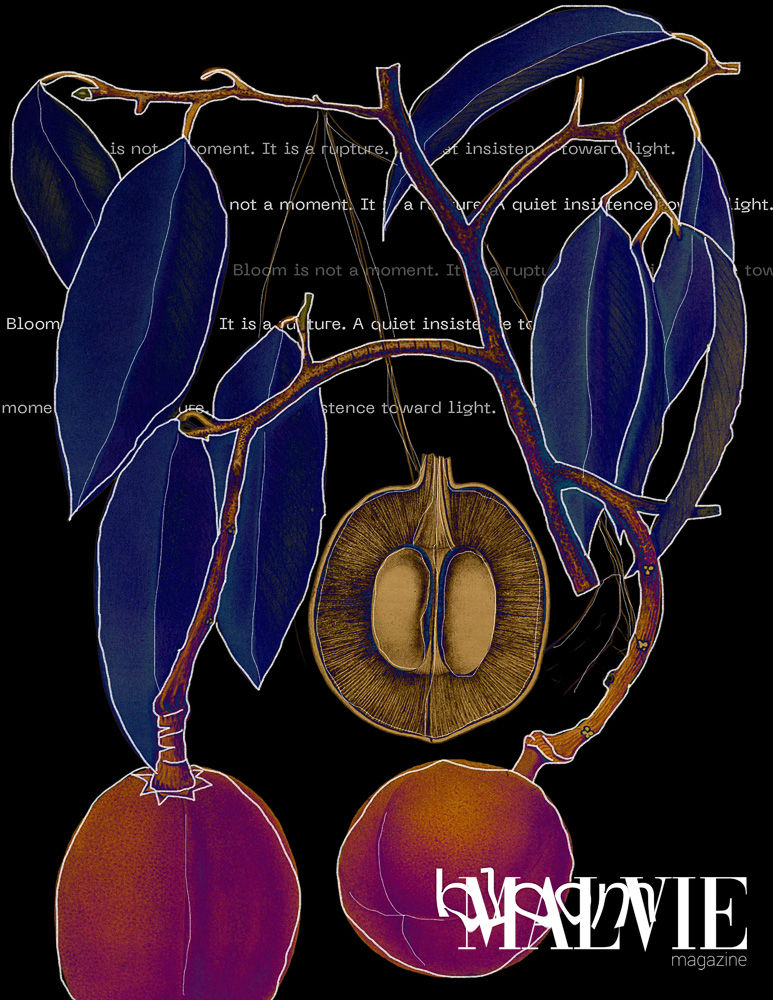
Andrea Antony: The series explores growth as a break in symmetry, where form expands through pressure and instability rather than harmony


Your practice moves fluidly between visual art, architecture, and user experience design. How do these different disciplines inform one another in the way you think about emotion, space, and interaction?
My practice sits between disciplines because I’m interested in how people experience space, whether physical or digital. Architecture taught me to think in terms of structure, scale, and movement, while UX introduced interaction and responsiveness. Visual design becomes the bridge between the two.Emotion, for me, emerges from how something is structured and encountered. Whether it’s a building, an interface, or a poster, I approach it as a system that guides perception and feeling.
You describe your work as a way of expressing what words cannot. When you begin a project, do you start from an emotion, a visual impulse, or a conceptual framework?
I usually begin with a conceptual tension rather than a fixed idea. It might start as a question or a contradiction, something that doesn’t fully resolve. From there, emotion and visual form develop together.I rarely separate concept from image; the visual language becomes the way the idea is tested and understood.
Having grown up surrounded by architecture through your mother’s influence, how did that early exposure shape the way you understand structure, composition, and storytelling in your visual work today?
Growing up around architecture made me very aware of composition and spatial relationships early on. I became interested in how elements relate to each other within a frame and how that relationship creates meaning.That influence carries into my work now, there’s always an underlying structure, even in more experimental or distorted pieces.
You originally trained in architecture before transitioning toward UX design. What creative freedoms did you discover in the digital design space that felt unavailable in the physical constraints of architecture?
In architecture, there are physical, material, and functional constraints that shape what is possible. Moving into digital design introduced a different kind of freedom, one where form can be manipulated without those limitations.In the digital space, I can explore instability, distortion, and transformation more freely. It allows ideas to exist in states that wouldn’t be structurally possible in the physical world.

Your project Bloom reframes the idea of growth through distortion and spectral transformation rather than traditional beauty. What conceptual questions were you exploring while developing this series?
With Bloom, I was interested in questioning the idea of growth as something inherently soft or beautiful. I approached it instead as a process that involves tension, rupture, and repetition.The series explores growth as a break in symmetry, where form expands through pressure and instability rather than harmony.
The use of archival botanical imagery in Bloom suggests a dialogue between history and digital manipulation. What drew you to these historical references, and how do they interact with contemporary digital aesthetics in the work?
The archival botanical imagery brought a sense of history, classification, and control. These images were originally created to document and stabilize nature.By digitally distorting them, I wanted to disrupt that sense of order and introduce uncertainty. It creates a dialogue between preservation and transformation, between what is fixed and what continues to evolve.
As someone working at the intersection of art and UX, how do you balance intuition and experimentation with the structured logic required in user-centered design?
I see intuition and structure as complementary rather than opposing forces. In UX, there’s a clear need for logic and usability, but intuition plays a role in shaping how those systems feel.In my personal work, I lean more toward experimentation, but the underlying thinking remains structured. It’s about finding a balance where systems can still carry emotional weight.
Your visual language often feels atmospheric and emotionally charged. How do you translate abstract feelings into concrete visual systems, whether through color, form, or composition?
I translate abstract feelings into visual systems by identifying their qualities, whether that’s tension, softness, fragmentation, or repetition.These qualities then inform decisions around color, composition, and form. For example, distortion can represent instability, while repetition can suggest persistence or pressure. The goal is to create a visual language that mirrors the emotional state without needing to describe it directly.

Digital culture and technological aesthetics continue to reshape contemporary design. Which emerging visual or technological trends do you find most intriguing or creatively stimulating right now?
I’m particularly interested in how digital aesthetics are becoming more fluid and less fixed, things like glitch, distortion, and synthetic textures that blur the line between organic and artificial.There’s also a growing shift toward more emotionally driven design, where interfaces and visuals are not just functional but expressive. That intersection feels very relevant to where design is heading.
Tools and software can often shape the way ideas evolve. What role do your digital tools play in experimentation, and how do they support your more exploratory visual process?
My tools are an important part of the process, but I try not to let them dictate the outcome. I primarily work with software like Photoshop, Illustrator, and Figma, using them as spaces for experimentation rather than just execution.Often, the process involves pushing tools beyond their intended use, layering, distorting, and iterating until something unexpected emerges.
Your work frequently blurs the boundary between the tangible and the intangible. In your view, what role should emotion play in the design of digital experiences?
Emotion is essential in digital experiences because it shapes how people connect with what they’re interacting with.Even in highly functional systems, there’s always an emotional layer, whether it’s clarity, tension, trust, or curiosity. I think design should acknowledge that and create experiences that feel considered, not just efficient.
Looking ahead, you’ve mentioned the ambition to build a multidisciplinary studio that merges digital and physical experiences. What kind of creative environment or projects do you envision emerging from that space?
I envision a multidisciplinary studio that works across both digital and physical mediums, where design isn’t confined to screens but extends into spatial and experiential work.The goal would be to create projects that explore interaction, emotion, and environment in a more holistic way, bridging the gap between systems, spaces, and human experience.
Graphic Artist: Andrea Antony @andreaantony.des


Great post—really insightful and well put together! It’s always refreshing to see content that highlights such an important and evolving space.
Digital marketing for private schools is no longer optional—it’s essential. With parents increasingly turning to online platforms to research and compare educational options, having a strong digital presence can make all the difference. From targeted social media campaigns and search engine optimization to engaging website content and virtual tours, schools can build trust, showcase their unique strengths, and connect more effectively with prospective families. When done right, digital marketing not only boosts visibility but also helps create a strong, credible brand identity in a competitive landscape.
I started Marble Sort because the visuals looked clean, and stayed because the puzzle logic actually has teeth. You’re always choosing between finishing a three-slot box now or unburying a color you’ll need in thirty seconds.