
Between Mathematics and Menswear: The Visionary World of Yumeng Li

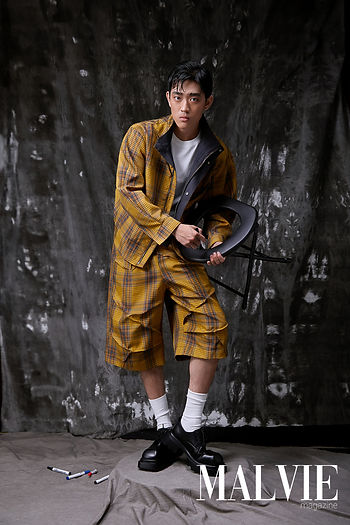
Your practice moves fluidly between mathematics, fashion, and business strategy. How do these disciplines interact in your creative process when developing a new collection?
These three disciplines do not exist independently in my system; rather, they form the underlying logic, the medium of expression, and the commercial execution strategy of my designs. My rigorous mathematical training at UCLA conditioned me to deconstruct complex, emotional forms using rational thinking. When developing a new collection, mathematics serves as the absolute core logic in pattern making. Every fluid pleat and seemingly effortless drape is backed by precise spatial geometry and topological deduction. Fashion is the visual outlet through which I express my "Fluid Aesthetics" and reshape modern menswear silhouettes. Meanwhile, business strategy—informed by my MBA studies at HKU—ensures these avant-garde concepts accurately reach the market. Particularly in 2026, which marks the inaugural year of YUNMOONMOON's commercial upgrade and scalable growth, the synergy of these three disciplines constitutes the brand's ultimate moat.
YUNMOONMOON is often described as emotionally driven and concept-based. How do you translate abstract ideas like identity or spirituality into tangible garments?
I tend to materialize these abstract concepts through "Fluid Aesthetics," utilizing it as a weapon to subvert the rigid paradigms of traditional menswear. For a long time, menswear pattern-making and craftsmanship have lagged behind womenswear, remaining overly simplistic and confined by stiff lines. To dismantle this barrier, I boldly integrate the intricate, precise tailoring logic of haute couture womenswear into menswear. I deliberately discard the heavy, cumbersome nature of traditional men's clothing, opting instead for pioneering fabrics that are breathable, lightweight, and sheer. Through this unisex, soft-sculptural approach, I juxtapose male strength with pure aesthetic beauty, encouraging men to stop viewing clothing as a uniform that conceals the body, but rather as a second skin that reveals their vulnerability and divine power.
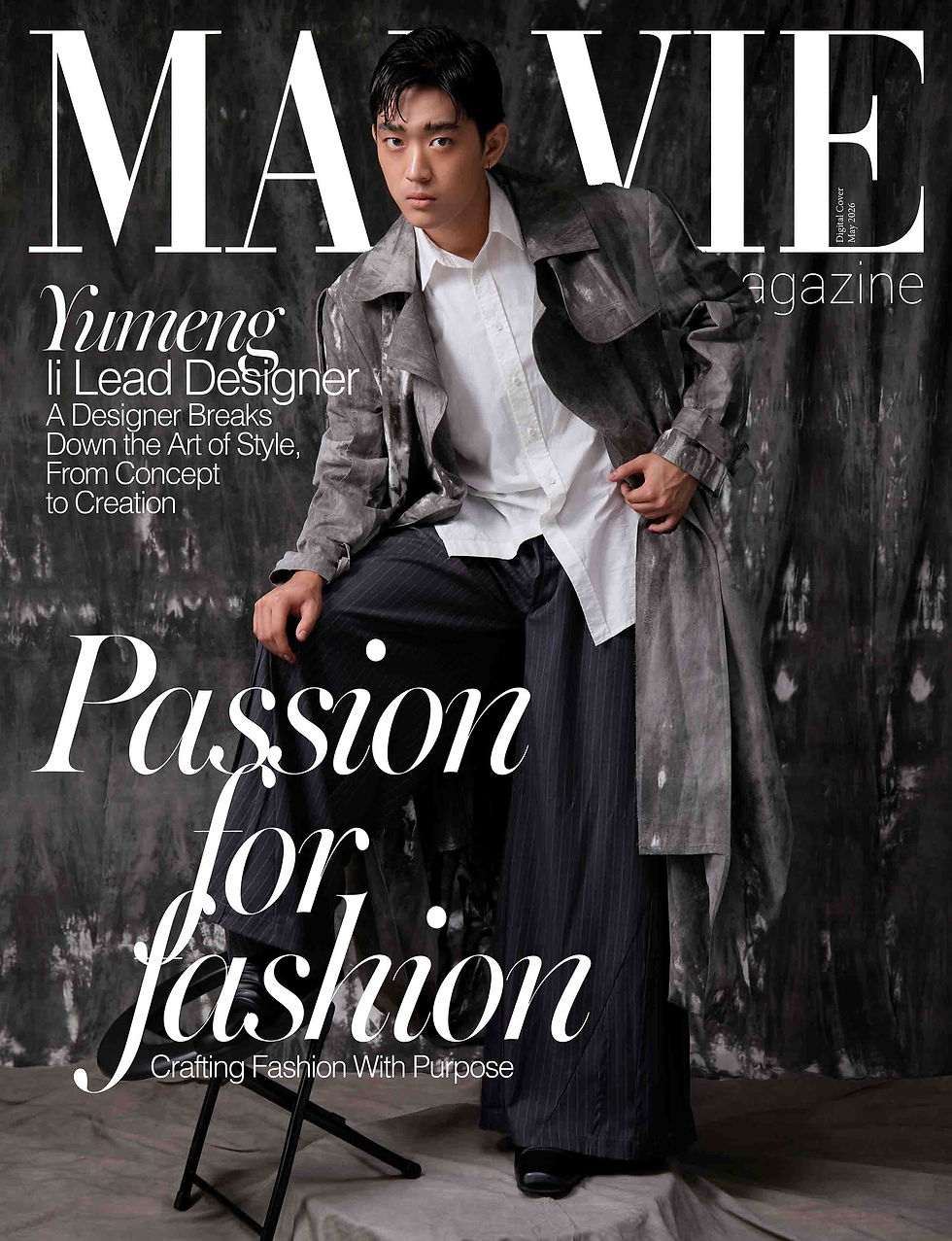
Your work emphasizes craftsmanship alongside technological innovation. How do you navigate the balance between tradition and experimentation in your design methodology?
Actually, my experimental approach is predominantly reflected in the revolution of pattern-making logic. We have broken away from the empirical limitations of traditional menswear, shifting the focus of haute craftsmanship to the precise control of mathematics and engineering. While incorporating haute couture womenswear techniques, we deeply apply parametric logic and spatial geometry in our R&D. How do you make extremely lightweight fabrics accurately contour the undulating muscles and bones of the male body while maintaining a fragile tension that seems on the verge of collapse? This relies entirely on pattern experiments grounded in rigorous mathematical deduction. Using rational pattern-making logic to carry profoundly emotional designs is the ultimate way to liberate creativity.
Having presented at both New York and Shanghai Fashion Weeks, how have these platforms shaped your perspective on global fashion audiences and industry expectations?
Showcasing multiple times at New York and Shanghai Fashion Weeks, as well as having my work featured in Times Square, has made me acutely aware of the global menswear market's immense thirst for avant-garde aesthetics. The industry is no longer satisfied with singular visual stimuli or conservative menswear tailoring. They expect a design language that possesses cross-cultural communication capabilities and truly liberates the physical body. The combination of highly original, lightweight menswear silhouettes with extremely rigorous pattern-making logic is entirely capable of transcending regional aesthetic barriers.

Your Electric Crochet Hook reflects a deeply human-centered approach to design. What inspired this innovation, and how do you see tools like this reshaping the future of textile craftsmanship?
The original intention behind this invention was highly personal. I watched my grandmother struggle with hand muscle fatigue and joint strain as she aged while continuing her traditional handcrafts. To help her, and countless other professional creators, comfortably extend their creative lifespan, I developed this ergonomic electric crochet hook, which was granted a utility model patent in 2025. I believe the true significance of such tools lies in the "liberation of the physical body." The future of the textile industry should not rely on the physical wear and tear of its creators. Only by substituting heavy, mechanical labor with advanced tools can designers pour their core energy into macro-aesthetic construction and challenging structural pattern deductions.
Many of your collections feature sculptural silhouettes and material exploration. Could you walk us through how a single concept evolves into a finished piece?
Take my exploration of classical art history, for example. The ultimate depiction of male physical beauty in ancient Greek sculpture is a crucial source of inspiration. The first step is not blindly cutting fabric, but rather entering the academic context of my PhD research in Fiber Science & Apparel Design at Cornell University to conduct mechanical and geometric analyses. We use mathematical logic to calculate the drape and tension of lightweight fabrics during physical movement. We deduce the spatial relationship of womenswear techniques applied to the male skeletal structure on flat paper patterns, exploring a new morphology where strength and softness intertwine, ultimately translating this into physical prototypes with unparalleled precision.
Your work has been recognized by institutions such as Harper’s Bazaar, ELLE, and Vogue. How do these recognitions influence—or not influence—your creative direction?
Recognition from top-tier fashion media, alongside professional accolades such as the Silver Muse Design Award and the Silver Award at the International Contemporary Youth Art and Design Competition, serves as a vital endorsement of both my commercial value and academic originality. They provide the brand with a broader international perspective and authoritative voice. However, this does not alter my core creative direction; rather, the spotlight acts as a magnifying glass, giving me the confidence to persist in my uncompromising avant-garde expression and boldly deconstruct menswear.
Sustainability is often discussed in fashion, but your work approaches it through both material innovation and social impact. What does meaningful sustainability look like in your practice?
Meaningful sustainability must be structural. On the environmental front, by utilizing extremely rigorous mathematical calculations and pattern logic, I deduce structural rationality directly from the design source. This drastically improves prototyping accuracy, significantly reducing the massive resource waste caused by repetitive trial-and-error in traditional development. On the social impact front, much like my electric crochet hook patent, focusing on the occupational health and ergonomics of the creators themselves—protecting the industry's fundamental "resource of creativity"—is a profoundly humanistic form of social sustainability.
How do you position YUNMOONMOON within the broader fashion landscape, and what kind of dialogue do you aim to create with your audience?
I position the brand as a vanguard bridge that subverts traditional masculinity, connecting "rigorous mathematical structures" with "classical romanticism." As the brand's commercial footprint expands, I hope to establish an empowering dialogue: encouraging men to break free from traditional sartorial constraints, to no longer view clothing as a uniform to hide behind, but to courageously appreciate and reveal the beauty, vulnerability, and power of their own bodies.

Collaboration can play a key role in expanding a brand’s vision. Are there particular partnerships or creative exchanges that have significantly shaped your work so far?
Merging avant-garde menswear with pop culture artists who wield massive influence is a crucial commercial validation for us. In the current commercial landscape, we are in the explosive growth phase of both the "Male Beauty Economy" and the "Fan Economy." Our deep collaborations and performance wardrobe support for top-tier Chinese celebrities—such as Cai Xukun, Zhu Zhengting, Liu Yuning, Chen Chusheng, and Liu Yu—perfectly align with these two powerful market waves. Watching my soft-sculptural designs, which fuse haute couture womenswear techniques with sheer fabrics, take on new life through their dynamic stage performances deeply enriches the brand's visual dimensions.
More importantly, the momentum generated by this "dual-economy" directly proves the immense explosive potential of our avant-garde aesthetics in the mainstream market, successfully attracting strategic attention from top-tier investors. Currently, to welcome the inflection point of the brand's scaled growth, I am fully preparing our Business Plan (BP) and will soon launch a capital roadshow. I hope to leverage commercial capital to comprehensively expand the influence of this avant-garde menswear and achieve a full leap into a mature commercial empire.
Your designs often feel like they exist between art and fashion. How do you define that boundary, and is it something you intentionally challenge?
This boundary is, in itself, an artificial construct. Inspired by masters like Vivienne Westwood, Rick Owens, and Alexander McQueen, as well as the glam rock spirit of David Bowie, I have always been dedicated to reshaping the theatrical narrative of men. From the classical sublimity of Greek temples to the rebellious deconstruction of androgynous Goth, my goal is not to challenge the boundary, but to dissolve it entirely—giving art a utilitarian shell and endowing menswear with a pure aesthetic worthy of reverence.
Looking ahead, what kind of long-term impact do you hope to have on the fashion industry—both creatively and structurally?
Structurally, I hope to push the industry to re-examine pattern-making craftsmanship, elevating it from a traditional, experience-driven practice to a precise discipline of spatial engineering, thereby dismantling the technical barriers between menswear and womenswear. Creatively, I am committed to establishing this "fluid style"—which showcases male body aesthetics and an atmosphere of pure desire and vulnerability—as a globally influential design movement. I want to prove that rational geometric logic (Mathematics) and devastatingly romantic emotion (Avant-garde Art) can not only coexist but can incubate a disruptive era of haute couture that completely reconfigures the definition of traditional menswear.


Fashion Designer: Yumeng li @yunmoonmoon

Comments