
Nana Dola: When someone sees their image, I want them to recognize a version of themselves they never allowed before. Not a transformation—but a realization: this was always there, waiting to be seen.

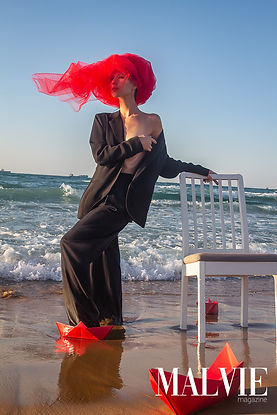
Your work describes photography as a dialogue between the soul and the creator. How do you recognize when that dialogue has truly begun within a session?
I understand that the dialogue begins at the moment when a shared state appears between us. This is a very subtle space: for a person, it is their own line of the soul, which can be revealed only in conditions of respect and care for their state.
And in order to guide this without pressure, I enter this state together with them — and then a real dialogue arises between us.
You speak about moving beyond performance into presence. What allows a person to cross that threshold in front of your camera?
I conduct the dialogue already holding the camera, and I enter this state together with the person. I begin to live it aloud — through words, through intonation, through attention to the emotional points that resonate within them. I seem to hold this state for the two of us and gradually intensify it.
At this moment, they stop feeling separate or observed — they feel that we are living this together. My experiencing becomes the word, theirs — the body.
And in this connection, authenticity arises, where performance simply has no place.
You describe the photoshoot as an “initiation of meaning.” What shifts internally for you when you move from creating images to facilitating that kind of experience?
Inside me at this moment a very subtle state arises — a sense of reverence and the feeling of the significance of what is happening.
I feel that I am in my place: not simply creating a form, but helping a person’s soul to reveal itself.And this gives a sense of depth and meaning, in which beauty becomes not a goal, but a consequence of an inner movement.

There is a recurring movement in your philosophy—from control to feeling, from image to presence. How do you guide someone through that transition during a shoot?
As a psychologist, I transferred this process from words into the body — and this is precisely what makes it alive: less resistance, more movement, more truth. A person stops holding themselves back and allows the soul to manifest where it was previously stopped by control.
This can be called a symbiosis of psychology and art.
During the shoot, several levels are engaged at once: movement, attention, holding the state, thought. Together, all of this creates the effect of deep immersion, in which controlling oneself becomes almost impossible.
Unlike classical work through conversation, where a person remains in their head, here they experience themselves holistically — through the body, feeling, and inner state. And that is why the result manifests faster, deeper, and becomes visible.
I believe that in such moments, when it becomes possible to reveal the soul and allow it to speak instead of the mind, a person becomes a work of art in the frame. Because they are dazzlingly beautiful in their openness. And this is what art as a whole strives for.
I have only found a way to open access to this.

You often begin with a conversation about the client’s current state and desired transition.
How does that dialogue shape the visual outcome of the shoot?
Even when we sensually speak about the current state, we formulate a specific task — a transition that the person wants to live through.
It is not abstract: it has a theme, a state, and a direction. Based on this, we select a metaphor and details that become carriers of meaning.
Each element in the frame is not accidental.
Accessories, textures, space — everything works as a symbol of the inner process.
Thus, the visual language of the shoot is born from dialogue: from a precisely formulated state that we translate into an image.
When someone encounters their image after such an experience, what do you hope they recognize about themselves that they didn’t see before?
I hope that in the process they will enter the experience so deeply that they lose their habitual way of expression and allow themselves a state in which they previously did not allow themselves to be.When we allow the body and psyche to live through an emotion, it stops getting stuck — it passes. The body becomes more alive, more free. And then, when they see the result, they perceive themselves differently — as if looking at themselves from the outside for the first time, without habitual behavior.
And here surprise arises:they see their gestures, facial expressions, the precision of movements — and realize that their body can be expressive, strong, beautiful. Sometimes it sounds very simple:
“This is me? I’m somehow different here… and I like myself like this.”
And this is exactly what changes her. Not an external gaze, but her own recognition of herself in a new depth.
Model: Natali Hreben @natali_greben
Photographer: Nana Dola @nanadola_photographer

Finding the correct website matters, especially when similar names appear across different pages. I was searching for the Raxi Win Official Website: https://raxi.top/ and think visitors should verify the domain before entering account details. It is also worth checking whether the information on the page is current and clearly explained. Anyone looking for the Raxi Win Official Website should be careful with unrelated links and avoid sharing passwords or verification codes with unknown people.
Me parece positivo encontrar recursos que permitan consultar información de manera sencilla. En particular, loteria nacional puede ser una referencia útil para quienes desean revisar datos de sorteos, comparar información y encontrar rápidamente aquello que necesitan.
The idea of entering someone's state without pressure reminds me of what therapists call "affect attunement" — it's less about guiding and more about the other person feeling safe enough to let their guard down naturally.
Check visa
the idea of holding space for someone until performance drops away and presence emerges. As someone who also works between photography and digital privacy, I've found the two overlap more than people expect — every image that reveals someone truthfully also carries a responsibility around who else appears in the frame, especially in shared or public shoots. I've started using a face blur tool (https://www.blur.me/blur-face-in-photo/) to handle that quietly in post, and for batch editing entire shoots I lean on batch photo processing (https://www.blur.me/blur-image/) so the focus stays exactly where the artist intended it.
I found Dm win apk useful while practicing MATLAB problems, especially for understanding logic errors and improving my coding approach.