
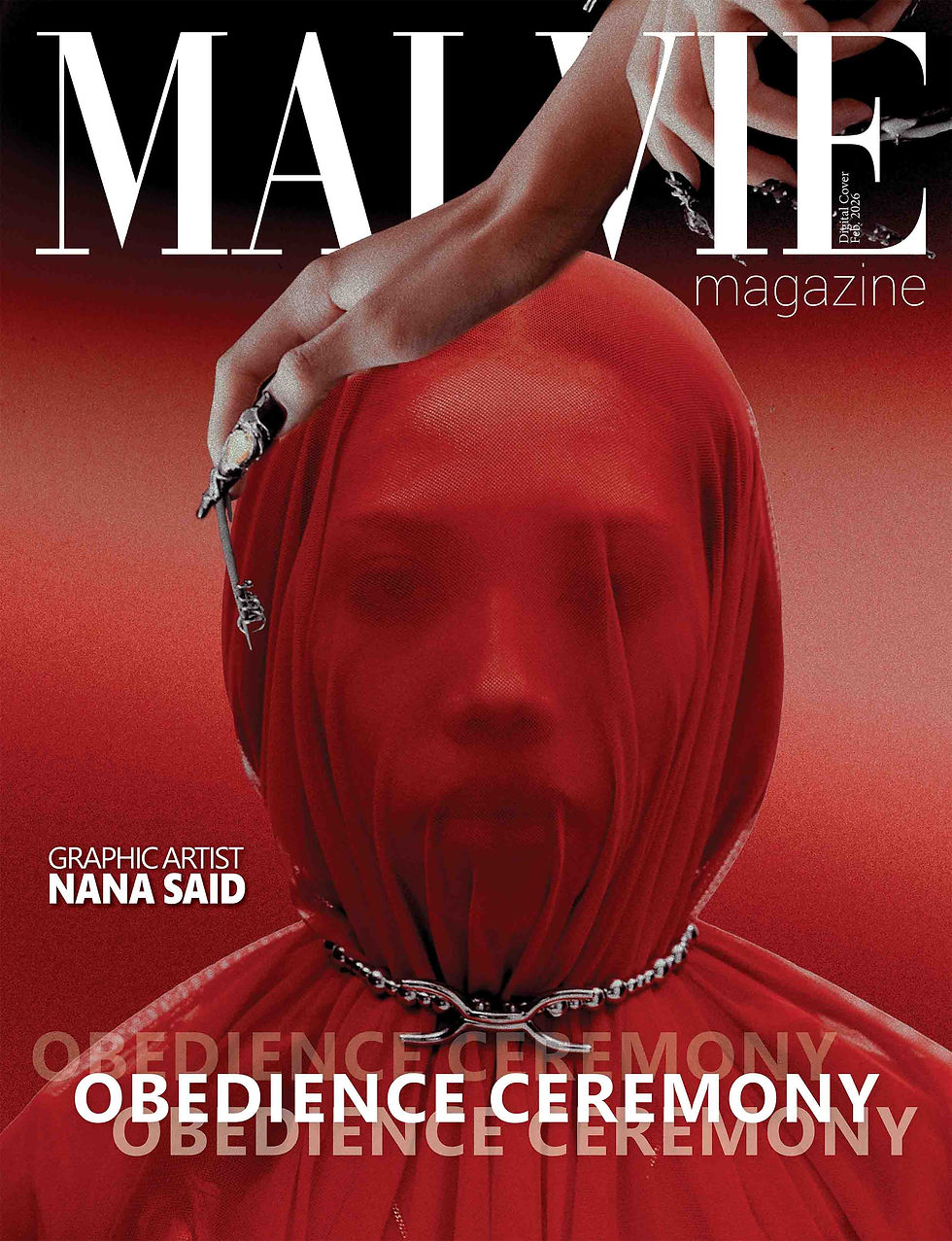
Nana Said: Design is how I give form to emotion, memory, and lived experience.


Can you describe your design practice in your own words, beyond titles or disciplines?
My practice is about shaping meaning through visual systems. I’m interested in how design can hold emotion, memory, and context; how it can communicate something felt rather than just seen. I work between structured design systems and more intuitive, experimental graphic work, often using design to understand people, environments, and cultural narratives.
What does it mean to you for a person, client, or community to be felt through design rather than simply represented visually?
To be felt means the work carries the tone, values, and presence of the person or community behind it. Rather than relying on literal symbols or surface aesthetics, I focus on rhythm, restraint, materiality, and structure; subtle cues that allow someone to recognize themselves in the work emotionally, even if they can’t immediately articulate why.
How has growing up between cultures and languages shaped the way you see, think, and communicate through design?
Growing up between cultures and languages made me acutely aware that meaning is rarely singular. The same gesture, color, or word can hold different weight depending on context. Design became my way of navigating those gaps; of communicating what couldn’t always be expressed verbally. It taught me to listen closely, work with nuance, and design for interpretation rather than fixed answers.
Do you consider design a form of translation? If so, what are you translating through your work?
Yes, absolutely. I see design as a form of translation between people and systems, emotion and structure, culture and contemporary context. I’m often translating lived experiences, personal histories, or collective values into visual language that can resonate with diverse audiences while retaining specificity.
Where did your interest in themes of ritual, community, and identity originate, and how do these themes show up in your graphic work today?
These themes come directly from my upbringing. Ritual and community were deeply embedded in everyday life, shaping how people gathered, communicated, and marked time. In my work today, this shows up through repetition, systems, and gestures that feel intentional—design choices that echo continuity, and shared experience.

How do cultural context and environment influence the emotional responses you aim to create in visual systems?
Cultural context determines how visual language is read and felt. I pay close attention to the environment, physical, social, and historical, because emotion often comes from familiarity or contrast. Whether through scale, texture, spacing, or pacing, I aim to create systems that feel grounded in their context rather than imposed on it.
How do you navigate the space between structured design systems or branding and more personal visual experimentation?
I don’t see them as opposites. Structure gives me a framework, while experimentation allows space for intuition and discovery. Often, the most personal moments emerge within constraints. I let systems carry clarity and consistency, and I use experimentation to introduce vulnerability, tension, or softness.
In collaborative or client-based projects, how do you work to understand a person or community beyond surface-level aesthetics?
I start by listening—asking questions about values, references, habits, and how they want to be perceived versus how they actually operate. I’m less interested in visual trends and more interested in behavior: how someone works, gathers, speaks, or builds relationships. That understanding shapes the design decisions from the inside out.
How does being an Egyptian designer based in New York inform your sense of identity and authorship?
It places me in a constant state of translation. I’m always negotiating between histories, visual languages, and expectations. That distance gives me clarity but also responsibility; I’m conscious of authorship, representation, and how much of myself enters the work. It’s a position that encourages reflection rather than certainty.

How do psychological dimensions—such as emotion, memory, or perception—factor into your approach to visual communication?
They’re central to how I think about design. I’m interested in how small visual decisions can trigger recognition, comfort, or curiosity. Memory and perception influence pacing, hierarchy, and tone; often guiding subtle yet emotionally precise choices.
What role does experimentation play in exploring identity?
Experimentation allows me to ask questions without needing immediate answers. In my personal work, especially, it becomes a space to test visual instincts, revisit memories, and explore identity in a non-linear way. It’s where uncertainty becomes productive.
What questions or tensions around identity, community, or visual language are you currently most interested in exploring?
I’m interested in how identity can be communicated without overt symbolism; how restraint, absence, or repetition can say just as much as explicit markers. I’m also thinking a lot about collective identity: how design can reflect shared values without flattening individuality.
Graphic Artist: Nana Said @stuudionana

A NEET rank predictor by marks can give students a rough idea of their expected AIR based on previous year trends, difficulty level, and competition. It’s useful for shortlisting colleges early, but actual ranks may vary depending on normalization and total qualified candidates.
a sassa status check allows south africans to follow their grant application online. with an srd status check, you can see whether your application is approved, pending, or declined. visit the official sassa website, enter your id number and registered cellphone number, and check for payment updates, delays, and appeal steps before deadlines.
I've been making crossword puzzles for my ESL class and this free maker saved me hours. You can customize the grid size and export to PDF directly.