
Beyond Words: Mirit Allon Halevi on Fashion, Architecture and Wearing Form


The fashion editorial Wearing Form was inspired by the architecture of The White Square at Edith Wolfson Park in Tel Aviv, Israel. It was designed by the late Israeli sculptor and environmental artist Dani Karavan. I was drawn to its geometric language and spatial rhythm, exploring the dialogue between body, garment and architecture through movement and space. The editorial features designs created primarily by Shenkar students, transforming geometry into a fashion narrative.
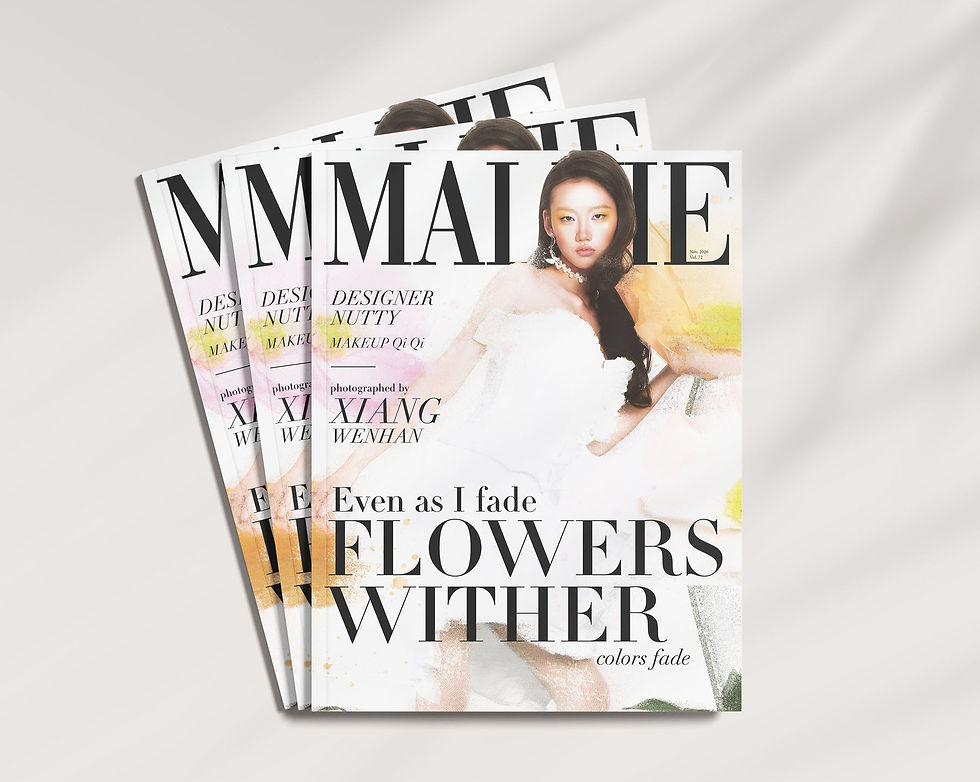
Wearing Form is one of the twenty editorials in MALVIE MAIN ISSUE 72, the 190-page, perfect-bound November 2026 main issue of MALVIE Magazine.

Order MALVIE MAIN ISSUE 72 in print:
Mirit Allon Halevi: the interview
You describe Wearing Form as the moment your love of photography and your lifelong fascination with clothing finally came together. Take us through how the story grew, from the first spark and the mood board to the final images.
Bringing different creative worlds together has been part of my creative language for years, each time taking on a different form. In Wearing Form, fashion and architecture came together naturally. I wanted to explore how they meet within a single image.
For me, clothes do not stand on their own. They gain meaning through context, through the person who wears them and the space they inhabit.
With that idea in mind, I began creating my mood board. I wanted to shoot outdoors, in an architectural space that carried meaning of its own. Dani Karavan's White Square whose work I greatly admire, became my choice. It was conceived as a tribute to Tel Aviv, a space to be entered and experienced through human presence and movement.
My fashion inspirations came from the work of Iris Van Herpen and Japanese Designers such as Rei Kawakubo and Issey Miyake. I was drawn to their use of volume, structure and geometry. These references helped shape the kind of garments I imagined moving through the space.
I chose a model who had the presence to carry the different shapes and volumes. I chose to keep the hair style and makeup minimal and clean, allowing the silhouettes to stand out within the surrounding architecture.
On the day of the shoot, the poses and the model's movement through space became an important part of the story. Her movement created a connection between the garments and the geometry of space. I began to see relationships that could not have been fully planned on a mood board. The final images grew out of what I had imagined beforehand and what happened in front of the camera. In that sense, Wearing Form became an evolving story.

An editorial depends on the people around the camera. How did you work with your creative team to turn the concept into something shared, and where did their input change your original idea?
The core concept of Wearing Form remained intact but the way it came to life became much richer through the collaboration.
Each member of my team received the mood board before saying "yes" to the project. They liked the idea and were excited by it.
Working with Polina, a stylist from the Shenkar Engineering. Design. and Art., whose alumni include internationally renowned fashion designer Alber Elbaz, opened an important door for the project. We were able to access unique pieces by Shenkar designers that strongly reflected the geometric language I had envisioned for Wearing Form. We spent a few days together searching for the right pieces. We were fortunate to work with three talented designers who were excited to participate in the project.
With Inbar, our hair and makeup artist, we decided to keep the hair and makeup consistent throughout the series. This created a visual thread connecting the different looks, while allowing the changing garments and geometric forms to remain the focus.
Alicia, our model, brought another layer through movement and presence. She was attentive, patient and willing to experiment. Her interpretation in front of the camera added something I could not have planned in advance.
On the day of the shoot, everything came together. We worked in full synchrony, professional and creative magic happened.
Moving to a new country every few years, clothes became a way for you to adapt and to belong. How does that early experience show up in the way you photograph fashion today?
The connection lies in movement, curiosity and openness to what is different from me. The experience of living in different countries exposed me to a rich experience of people, cultures and ways of life. It taught me to observe, adapt and remain curious.
I think this naturally found its way to my photography and art. I'm drawn to movement fleeting emotions, unexpected gestures, the swish of fabric, and the play between light and shadow.
My storytelling is through the relationship between the person, the clothes and the place. I see clothes as a reflection of identity, culture and belonging, a language beyond words.

Your professional life has been built around words, voice and language as a speech therapist. Has that work shaped how you tell a story through images, where nothing is said out loud?
My professional life has always revolved around words, voice and language. It taught me to pay attention to what exists beyond words. Communication is not only about what we say. It is also expressed through gestures, expressions, pauses and silence.
That sensitivity remains the same. What has changed is the medium. In fashion photography, I notice how a person moves in a garment, how the fabric responds to the body, a change in expression or the way light reveals texture and shape. These and many other subtle details can change the story of an image.
You want your photographs to make people feel, question or discover something beyond the clothes. What connections between fashion and other cultural worlds are you most drawn to, and how do you bring them into a single frame?
As I mentioned earlier, I am drawn to connections between different worlds but also to contrasts that inevitably exist between them. That tension is often what makes an image interesting to me. I am especially drawn to the dialogue between fashion and art, architecture history and cultural memory.
In Wearing Form for example, architecture isn't simply a backdrop for fashion. The concrete is solid, heavy and still, while the model wearing the designs is alive and in motion. In some images she seems to emerge from the concrete, in others she sits on it, leans against it or moves within it. The garment and the body sometimes echo the geometry of the space and sometimes seem to resist it.
I like leaving these relationships open to the viewer's interpretation. I don't necessarily want to tell the viewer what to feel. I would rather create an image that makes them pause and look again. For me, fashion photography can do this too – it can begin with clothes and everything that creates the look and lead the viewer somewhere beyond them.
Ten years into photography, what direction do you want your work to take next, and which ideas or stories are you hoping to explore in future projects?
Fashion photography excites me because of the many directions it can take me.
I am always in search of new and exciting projects, collaborations and fresh possibilities that can take my work in new directions. I explore different formats and mediums, from exhibitions to collaborations in media and advertising, while continuing to develop ideas that connect fashion with history, memory, objects, lifestyle and culture.
I will keep creating work that feels meaningful and leaves a mark.

Wearing Form credits
Creative Director and Photographer: Mirit Allon Halevi @mirithalevi
Model: Alisia (BNG Models) @alisxxs
Wardrobe Stylist: Polina Khatyanov @_polina_khatyanov_
Makeup Artist and Hair Stylist: Inbar Kushmirak @inbarkush_makeup
Wearing Form fashion credits
Image 1 — Zara @zara_group_israel
Images 2, 7, 9, 10 — Yardeni Peretz @yardeniperetz
Image 3 — Vivien @viviencarlin
Images 4, 5, 6, 8 — Yalta Tzion @yaltatzion


Comments