
Alexandra Mot:I hope people feel the vulnerability, dark romanticism, and rebellious spirit woven into my work.


Your work merges Victorian-era elegance with the darker edge of post-punk and goth culture. What initially drew you to this unlikely dialogue between historical fashion and underground subcultures?
I always had a do-it-yourself attitude, which I got from my parents growing up. For me, learning to sew and crochet felt like an intuitive skill; if I really wanted to fix something or make clothing that I couldn’t get, I had these skills to make things happen. I’m also a very detail-oriented person; I can get lost in things for hours on end, so the beauty in Victorian, handmade garments was mesmerizing to me. I fell in love with gothic aesthetics first; it’s hard to describe why I started gravitating towards that style in the beginning. I believe it was finding beauty in something imperfect, unusual, and deeply immersed in emotions, an aesthetic that often gets misunderstood.
Black is also such an elegant, classic, timeless color; it can make you look attractive or help you blend in. There’s a lot more you can do with it than most people realize. Post-punk music birthed goth rock, and the goth movement has drawn inspiration from gothic literature from Victorian times, like Edgar Allan Poe, Mary Shelley’s Frankenstein, or Bram Stoker’s Dracula, gothic horror stories that are dramatic, dark, and touch on subjects that were taboo at the time. Learning how the Victorian era was connected to the goth subculture really opened my eyes, and I connected the elegance, romanticism, and the curiosity and respect of inevitable death in both. The way Victorians handmade their garments and how alternative scenes had to DIY their own also drew a correlation to me.

Crochet is traditionally associated with craft and domesticity, yet in your hands it becomes something dramatic and almost theatrical. How did you begin transforming this technique into a medium for high-fashion and stage design?
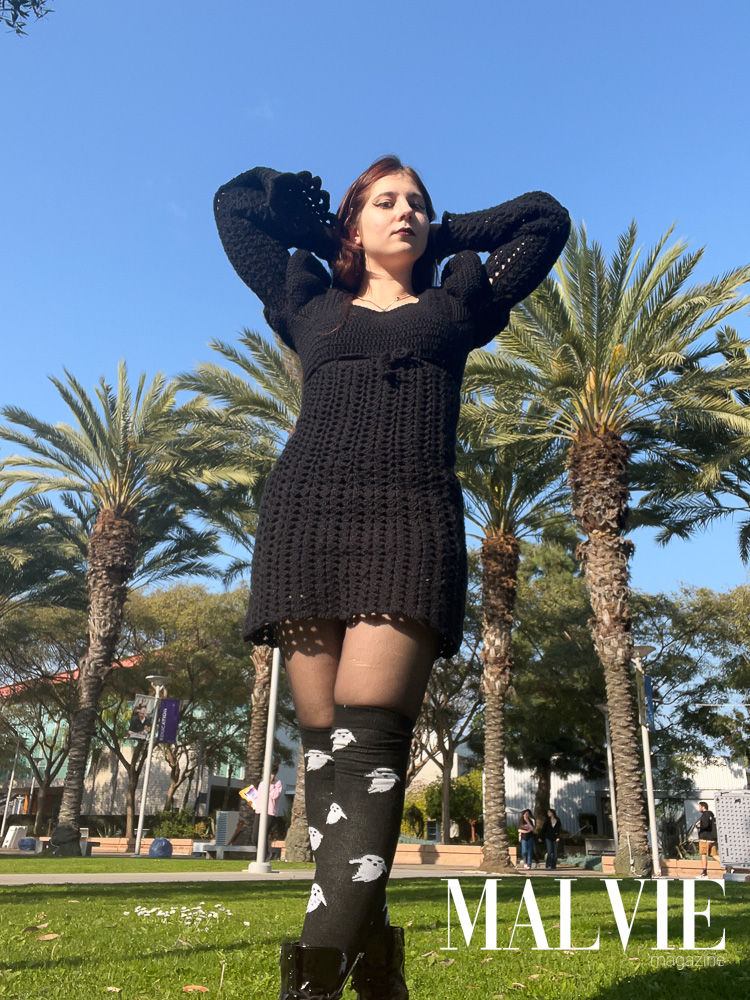
For some people, when they first hear of crochet, they’d think of table runners and doilies, but Millennials and Gen Z revolutionized crochet. A lot of young people started taking up the hook, especially during the pandemic, and learning the craft. I was exposed to all these wonderful and fresh ideas on social media. I was extremely inspired, and I wanted to try making clothing just like my favorite creators. It blew my mind how far you can take crochet; it’s like 3D printing with some yarn and a hook. After learning to sew, it was a completely different approach, essentially creating the textile while the piece works up, and sewing is a lot more minimal in crochet clothing.
My beginnings started with plushies for my boyfriend, which admittedly aren’t the most beginner-friendly projects (thick yarn, new language of written patterns, etc.), but I took on the challenge. Making clothing afterwards was like a piece of cake! After making more and more, I wanted to see how I could translate this technique into wearable art, sharing whimsical and gothic elements with either structured or more delicate garments.
Growing up in Hungary and later moving to Los Angeles must have been a major personal shift. In what ways has that transition reshaped your creative voice and the way you approach fashion?
I count moving to the other side of the globe as a part of my journey of growing up. It was the first big goal I set and achieved, and every step of the way made me stronger and learn faster, even at a young age. I realized early on that I needed to move to a fashion city if I wanted to take this seriously, but it took me a few years in high school to visualize my dream. I made the move for my education and career because Hungary is a small country where fashion is a tiny industry. Los Angeles is a great but very competitive place to start out in. I gained a lot of bravery from my partner, and I have to be very thankful for him. Moving here opened the doors to so many different paths and opportunities, and I couldn’t imagine how my taste would be if I had stayed in my country. It made me bold, and seeing people dress and present themselves unapologetically affected me in the best ways. I’m certain I would’ve gravitated towards my interests in dark fashion either way, but I’m a lot more confident now after the experiences I went through.

Your work often carries a sense of texture, layering, and handmade intensity. When you begin designing a piece, do you start with a visual image, a historical reference, or a feeling you want the garment to evoke?
I usually have a visual image in mind first then I make a few sketches. I think of it as having different folders in the back of my mind, tucking away information and inspiration all the time. A folder for Victorian fashion, gothic elements, textures, scents, music, feelings and the like. Then a few ideas combine together from various folders and I’m ready to make that a reality.
I’m usually not the one to make a moodboard first, I would rather do that after getting the ideas translated to sketches and sorting the looks out based on a board created afterwards, in case I had the opportunity to create a bigger collection, as I’ve only done capsules before.
The Victorian era is rich with symbolism, structure, and romantic darkness. Which elements from that period continue to influence you the most, and how do you reinterpret them for a modern audience?
The easiest garment to reinterpret is the corset, as it’s popular as a fashion garment nowadays. I love incorporating ruffles and puff sleeves into my designs. Victorian tops could be translated into corsets, structured tops, or even jackets. I’m experimenting with this line of ideas; obviously, the huge layered skirts with petticoats couldn’t be brought back as they would be very inconvenient to wear on a daily basis.
Another era I like to mix in is the late 60s/early 70s, especially the occult and “witchy” elements of it. It’s like mixing Black Sabbath with Stevie Nicks. I like heavy and dark, but it has to be balanced with femininity.
The DIY ethos of alternative music scenes seems deeply present in your approach to sustainability and upcycling. How has that underground culture shaped your philosophy as a designer?
I was introduced to thrifting and recycling fabrics first out of necessity, not ethos, growing up. My family wasn’t the one to frivolously spend on fashion items, so my mom would take me to thrift stores, and the excitement of the hunt stayed the same. After discovering more about the industry’s pollution, I learned it’s a bigger issue than I thought. In my hometown, the selection of fabrics was sparse, so I turned to thrifting garments and patching pieces together, Franken-style. Here, LA’s fabric district is a treasure trove of dead stock fabric, and it’s budget-friendly too.
When goths first started creating their style, there were no clothing labels making items specifically for them; it was too niche, and also in the early stages. They had to DIY, rip things up and sew things together, use safety pins, and decorate their jackets or bags. They had to make do with whatever they could find, and the approach felt familiar to me, even though I wasn’t exposed to these scenes in my time in Hungary.
You’ve already collaborated with musicians and performers such as Elyanna. What excites you most about designing for stage and performance compared to traditional fashion contexts?
It’s an entirely different world from commercial fashion; the lack of need to produce huge quantities, but only one-of-a-kind ones, is freeing. Stage clothes are more dramatic, exclusive, and serve a purpose for a memorable event. It felt like I was a part of something significant and unique. My dream will always be to start my own label, but l working in costumes or stage fashion seems irresistible to me in a way. I will have to see which way this bustling city takes me. Sometimes, I feel like I have to trust myself to go with the flow and feel out what to specialize in.

Designing for performers often requires balancing storytelling with practicality. How do you approach creating pieces that are visually striking while still functioning under the demands of a live performance?
Material choice is everything for performers. You have to keep in mind durability, wrinkling, stretch, comfort, and breathability as well. Once the right materials are acquired, adding dramatic silhouettes that are visible to every fan, even in huge crowds, is crucial. The shine of the material is a thing to consider as well. Proper and quality sewing is key; the last thing you’d want is to create wardrobe issues for someone performing on stage.
Your journey began with designing tiny outfits for Monster High dolls. Looking back, do you see traces of that early imagination still present in the way you design today?
This fashion doll line was my introduction to various alternative styles as a child, as well as horror characters packaged in a way that isn’t too scary for the target audience and doesn’t weird out the parents (too much). One of my favorite characters, the daughter of Dracula, dressed in a modern-Victorian, gothic-lolita style that probably imprinted on my mind even before understanding what this style was. One of my looks from my graduate collection was based on modernizing Victorian elements, and it included an exposed hoop skirt that I wanted to create and style ever since seeing it on a steampunk Monster High doll I still own from my childhood. There are a lot of bits and pieces that shaped me growing up, and I’m recognizing the way they stayed with me is comforting.
Working with materials that are reclaimed or upcycled introduces unpredictability into the process. Do these limitations challenge your creativity, or do they become a source of inspiration?
They absolutely do the opposite of limiting me, when I’m working with upcycled materials, there’s a purpose of incorporating them into the design and showcasing the textiles. I consider matching shades and textures, fabric weights, to make sure the piece looks cohesive and intentional. Ever since I focused more of my time on crocheting, I left upcycling behind a bit, but I’m planning on picking it up again. I guess as artists, we go through different phases.
You’ve described wanting to create work that feels lasting and meaningful. When people encounter your designs years from now, what do you hope they will feel or understand about your vision?
I’m both interested in creating wearable but unique garments as well as statement pieces that I could provide for the stage or performance. My goal is to create custom orders or limited production pieces in the end.
I hope people will understand the passion, intricacy, and emotional depth in my work.
I’d want them to feel the vulnerability and dark romanticism, but also the rebellious nature of my darkly inclined style.
Fashion Designer: Alexandra Mot @babybatblossom

Looking for meaningful wishes, this helped quite a bit: https://101pryvitannia.com/