
Melissa Alvarado Sierra: “The body remembers what the mind insists on forgetting.”


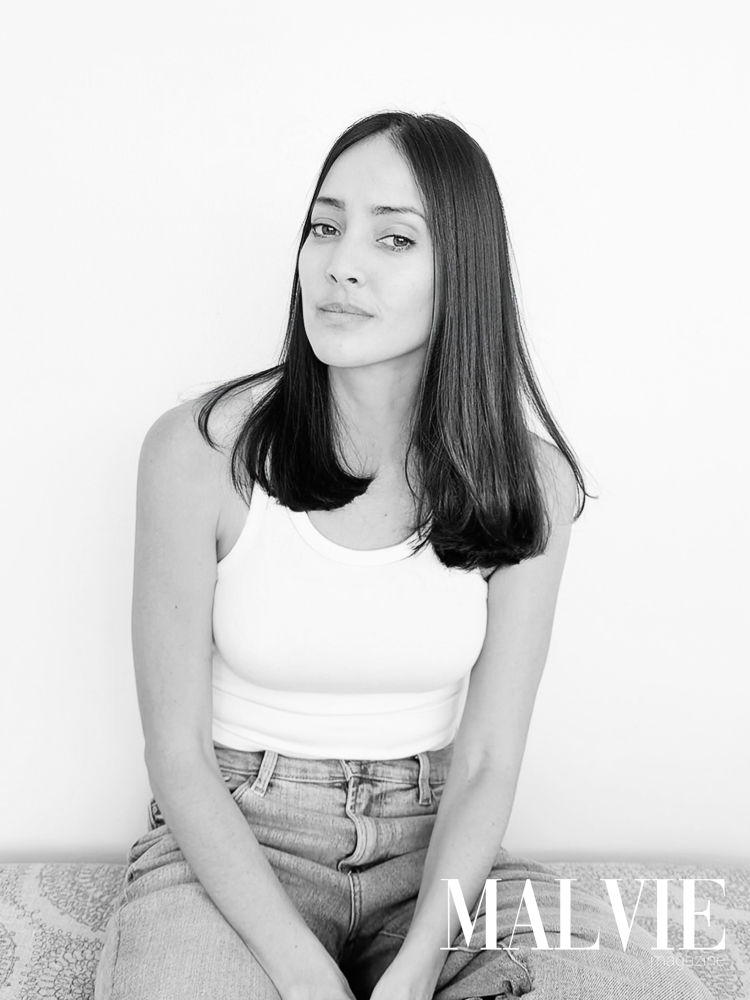
There’s a stillness to writer Melissa Alvarado Sierra, the kind that comes from having lived several lives and survived all of them. When she steps back in front of the camera, barefaced in jeans and a white shirt, it’s not a return to fashion so much as a return to a truer self. Once a model for Carolina Herrera, Peroni, and Jansport, Alvarado Sierra left the industry in 2010, disillusioned by its relentless choreography of perfection. Fourteen years, two cancers, and a long list of published work, she’s back before the camera.
Her images for this story are intentionally unadorned. No elaborate styling, no artifice, just a woman who has learned to live with and within her body. The simplicity feels radical. It mirrors the evolution of her literary work, which traces in a minimalist way the shifting terrain between memory and the act of turning experience into language.
Our conversation drifts from literature to beauty, from the rituals of survival to the uneasy privilege of being visible. As Breast Cancer Awareness Month unfolds, Alvarado Sierra speaks candidly about her experience with a breast cancer diagnosis back in 2021 and how life looks like now that she's in remission.
Her return to modeling feels like an experiment in what happens when a woman revisits the site of her former silencing and refuses to disappear.

You began your career in the fashion world before becoming a writer. How did your time as a model shape the woman and artist you are today?
Modeling was my first education in how the world sees women. For more than a decade, I worked in an industry that depended on my youth, my body and in many instances, my silence. Others called it glamorous and in many ways it was, but it was also exhausting. There was pressure to erase my self, to be smaller, quieter, ageless.
That experience showed me how sometimes women learn to translate themselves into something “acceptable.” Writing helped me undo a lot of that training. It gave me a way to speak without needing permission. Modeling turned me into a very outspoken writer.
You’ve described returning to modeling in your forties as “a reclamation of self.” What does that phrase mean to you now, and how has your perception of beauty evolved over the years?
When I was younger, beauty was a kind of currency. I learned early on that being looked at could open doors but also close them, that once people decided what they saw, it was almost impossible to change their perception. The industry taught me to preserve an image of myself, not actually a self.
After surviving cancer, that construct collapsed. My relationship to my body changed, my reality changed. There was no returning to what I had been, only to what was left. And what was left was more beautiful and real. It meant returning to my younger self before modeling.
“Reclamation” means accepting that the surface is never the whole story. It means I no longer need to perform youth, or conventional beauty, or the illusion of untouchedness to be a model. The woman who stands in front of the camera now is marked by time and she is just as worthy as the teenager who started modeling so many years ago.
Beauty, as we were taught to chase it, was about a constant disappearance. Reclamation is the opposite. Reclamation is about remaining visible.
After stepping away from the industry in 2010, what inspired you to reconnect with it now, at a moment when fashion is beginning to celebrate age and individuality?

This moment feels like a small but meaningful correction, one I hope extends beyond magazine pages and into daily life. Yet I sometimes feel almost foolish talking about fashion at all, when so many devastating things are happening in the world. The idea that being able to model in your forties qualifies as progress feels fragile, even precarious, in the current political and cultural climate. It’s hard not to sense that these advancements (celebrating diversity, aging, individuality) could vanish as quickly as they appeared. We’ve seen how easily appreciation turns into retrenchment.
And still, I believe we must make room for beauty, even now, especially now. It’s not a distraction, but maybe a form of resistance? To create space for art, for image, for the body in its truth is to insist on a kind of brief reprieve that allows us to keep going.
So I return to fashion as a witness. I’m here to test whether visibility can mean something more this time. I’m a Puerto Rican woman in my forties, a cancer survivor, standing before the camera not as an ideal or symbol, but as a person insisting on presence. If I can transform that space into something better than it was last time, then even amid everything else, it becomes a small act of triumph and healing.
Your writing career has spanned multiple genres and platforms. How does your work as a writer intersect with your experiences as a woman, survivor, and model?
Modeling taught me what it means to be interpreted and exist as an image shaped by other people’s expectations. Cancer forced the opposite lesson. A return to the body as a private, sovereign territory. Writing became the place where those two realities meet.
I write from the tension between visibility and interiority, between things seen and how it feels inside. After years of performing a certain perfection; cancer taught me to live with imperfection. I write to hold both realities at once.
Across genres my work tries to circle back what it means to inhabit a body that has been idealized, injured, and ultimately reimagined. Now I get to negotiate that complexity and transform what was silenced into language I control. Art isn’t separate from experience; it’s the act of making experience intelligible.
October is Breast Cancer Awareness Month. What message do you most want to share with others during this time?

To know that awareness has to mean more than pink ribbons or slogans. It has to mean turning toward what feels unpredictable. Getting a mammogram and waiting for the results. Making sure to know what’s going on in your breasts. Odds are that you will not have breast cancer, but if you do and you catch it early, you will probably be okay.
When I was diagnosed, the fear was immediate and consuming. It lived in my throat, in my sleep, in every ordinary moment. I went through chemotherapy and radiation, and there were days I thought I wouldn’t make it through the exhaustion, the sickness, the uncertainty. But I did. I’m still here. The chances of surviving early breast cancer and having a normal lifespan are very encouraging nowadays. This illness is survivable.
You can be terrified and still act, still show up for yourself. The worst thing you can do is look away from your own body. You have to meet what’s real, even when it’s unbearable. That’s how you survive it.
You’ve mentioned meeting women who delayed care while caring for others. What do you wish more women understood about prioritizing their own health and early detection?
That sacrifice is not always virtue. Women are often trained to think our value lies in service, to partners, to children, to work. I’ve seen how that thinking can be dangerous.
During treatment, I met women who ignored symptoms for months or years because they were too busy taking care of everyone else. They confessed believing they were being strong, but later understood that strength cannot translate to self-neglect. Strength is choosing to survive.
We need to redefine what care means. It must include ourselves.
Cancer changes people in profound ways. What were some of the “beautiful truths” that emerged for you through your journey?
Looking back, I can trace how years of fear, grief, and unrelieved stress gathered inside me creating a kind of internal weather system that never cleared. The body, I’ve learned, remembers what the mind insists on forgetting. It stores the unsaid. The fatigue, the resentment, the tears withheld for the sake of composure. Eventually, that accumulation finds a language of its own. It speaks through symptoms.
During treatment, I began to understand healing not only as a medical process but as a spiritual and psychological reckoning. Dr. Jeff Rediger’s book Cured offered one framework for that idea, the notion that recovery begins when something within shifts, when the body no longer perceives itself as under siege. In Ayurveda, this equilibrium is called sattva. A state of lucidity and harmony in which the body can do what it was designed to do, which is to restore itself.
Over time, I also came to understand, as Eckhart Tolle writes, that presence itself is a form of medicine. The moment I stopped identifying with fear and began to observe it without judgment, without a story, something loosened. Awareness didn’t eliminate suffering, but it gave it context, a place to move through. Of course, it’s not a lesson one completes, it’s a daily practice of returning.
Now I see cancer not as punishment or misfortune, but as a beautiful interruption that stopped me from constantly living in reaction and begin living more in alignment. To listen. To release what was never mine to carry. Healing became less about erasing illness and more about reconciling the split between mind and body, between past and present.

The body wants to live. I believe that once you stop waging war against it and learn to listen, it remembers how.
You believe in a balance between modern medicine and holistic healing. How did these approaches complement each other in your recovery?
I chose every tool available to me. I underwent chemotherapy, radiation, and cryosurgery. I remain closely connected to my oncologist, committed to surveillance and the protocols that scientific evidence demands. I trust conventional care because it saved my life. But I also know that while very powerful, modern medicine addresses only part of the equation.
Healing doesn’t end when treatment ends. I believe recovery, if it is to be complete, must reach a deeper terrain. I began integrating practices that helped me release what the body had been holding, things like meditation, breathwork, energy work, and Ayurvedic routines that cultivate balance through rest and digestion. Nutrition, movement, and time in nature became extensions of treatment rather than alternatives to it. I found ways of keeping the nervous system in conversation with peace.
From both research and experience, I’ve learned that prevention is not merely biological but also emotional and spiritual. The conditions for health are created by coherence, when mind, body, and belief are in alignment. For me, that means protecting my inner life with as much care as I give the physical. My priorities are managing stress, setting boundaries, and unlearning the reflexes that once normalized depletion.
I neither reject science nor sanctify it. I follow data, but I also listen to my intuition. To that inner intelligence that signals imbalance long before tests do. Medicine saved my life, but intuition, self-care and balance sustain it.
Art and writing often become forms of healing. How did creativity sustain or transform you during and after your treatment?
During treatment, I filled notebooks with observations of fear, fatigue, the metallic taste of chemotherapy. It wasn’t art; it was therapy and record-keeping.
Later, some of those fragments became poems, though I have little interest in publishing work from those days. I resist the expectation that cancer must become a defining narrative or a source of inspiration in my work. Cancer is something that happened to me in 2021; it shaped me as a writer, but it does not contain me or my writing.
What I want is to write about the texture of being alive, the ordinary grace of continuing. Everyone has known loss, illness, or despair; these are universal conditions. What matters is how we inhabit life afterward, how we turn those into gratitude, presence, and art.
Your current projects—a poetry collection and an autobiographical novel—sound deeply personal. How does revisiting your past through art help you make sense of your present?
By helping me trace the architecture of who I became and why. In my novel, I return to my teenage years in Puerto Rico, the sharp boundaries of class, the schools that taught me to pretend rather than express myself. Writing becomes a way of decoding those days.
There’s so much pleasure in returning to the past with the tools of craft. I can rescue moments that once felt ordinary or unbearable and give them structure, rhythm, and clarity. But I’m not interested in transcribing life; I’m interested in transforming it. And fiction allows me to reshape experience so that emotion becomes meaning and truth gains a form that memory alone can’t provide. The work is both excavation and reconstruction
You’ve said you live your life now like writing a poem: “slowly, with care, intentional as breath.” What practices or daily rituals help you embody that philosophy?
I try to move through the day with as much intention as possible. My ideal mornings are quiet, making tea, reading a few pages, writing a few lines, watching an episode of a beloved period show, all before the noise of the house and the world begins. I give myself the luxury of pondering before expression. Pausing is everything.
Mainly, I’ve tried to abandon the illusion of multitasking. I want cooking, reading, and walking to become forms of meditation. I’ve been semi-successful and when I live faster, I miss my own life entirely. I know that. The days blur into achievement, hurriedness, and stress. I try to inhabit time, not chase it.
But I still catch myself slipping. I scroll, worry, fragment my attention. Each return to slowness is an act of recovery. I have to be patient with myself.
Looking forward, what do you hope women—especially those facing illness, aging, or reinvention—take away from your story?
What I want women to understand is that life after any rupture belongs entirely to them. They have the right to define what healing, aging or reinvention look like, to reject the narratives that flatten their complexity.
It's a beautiful blessing to be able to start again. To redefine yourself and what it means to survive, grow older, and be free.
We’re happy to share a translated poem from her forthcoming poetry collection in Spanish, A mí me dieron la mar.
Return

Each season they find the rafters,
patch the nest, start again
a small faith stitched in straw.
They quarrel, feed, repair,
their bodies drawing cursive
through the thick salt air.
No myth in this, just hunger,
just weather, the insistence
of living things to stay.
I watch them from the balcony,
my own hands busy with something,
listening for what persists
after the tender noise of wings.
Wardrobe, Hair And Makeup: Lydia Amador @lamadorphoto
Model: Melissa Alvarado Sierra @melissacaribe

Everyone has different preferences when choosing a platform, but I usually look for something that's easy to navigate. That's one reason raja game login caught my interest. The overall experience appears smooth, and finding the main sections doesn't seem difficult. It's always better to understand the available features first instead of rushing. Doing that can help you get the most out of raja game login without any confusion.
Thanks for sharing this information. calculadora de finiquito sounds like a useful solution for employees who need clarity. Instead of feeling lost, people can review likely numbers and understand their position. calculadora de finiquito is simple, convenient, and valuable during career transitions.
I found matlab assignment help useful while practicing MATLAB problems, especially for understanding logic errors and improving my coding approach.
I started playing the Tigro Club game a few weeks ago, and the experience has been surprisingly good. The app loads fast, the graphics are clean, and the gameplay doesn’t lag. The daily bonuses and special tasks make the game feel more engaging. What I like the most is that it doesn’t crash randomly like many similar apps. Definitely worth checking out if you enjoy online gaming.
This thoughtful discussion on “You’ve mentioned meeting women who delayed care while caring for others. What do you wish more women understood about prioritizing their own health and early detection?” highlights an important message about self-care and awareness. Many women put others first, often neglecting their own health needs. As someone interested in Semaglutide Orange County, I appreciate how this topic connects to proactive health choices—reminding us that early detection and proper treatment are key to long-term wellness.